
Article

Turning science into customer value
Why great scientific products need more than great science to succeed
By Patrik Svalander, CEO & Founder, Svalander Life
Key takeaways
Scientific excellence alone rarely drives commercial success. Customers must understand the value your product creates.
Customers operate in an environment of limited time, competing priorities, and information overload. Even valuable messages can be overlooked.
Different stakeholders evaluate products through different lenses, from scientific performance and patient outcomes to operational efficiency and return on investment.
Product features and scientific capabilities only become persuasive when translated into practical benefits and meaningful customer value.
Effective communication bridges the gap between science and value, helping customers understand not only what a product does, but why it matters.
You’ve developed something great
It may be a product, a service, a solution, or an entire system. For simplicity’s sake let’s call it a product.
Your team has identified a need, invested significant effort in development, and created something genuinely valuable. You understand exactly how it works, the science behind it, and why it is superior to existing alternatives. Now comes what you might think is the easy part: bringing it to market and selling it.
But it’s rarely that simple.
Commercial success depends on many factors, including product quality, pricing, distribution, market access, and the effectiveness of your sales team. In this article, however, we will focus on one factor that is often underestimated: helping customers understand the value your product creates.
Scientific excellence alone is seldom enough. Potential customers must not only understand what your product does, but why it matters, and why they should choose it over competing solutions. Or over doing nothing at all, because in many cases, adopting a new product involves changing established routines, workflows, or purchasing habits.
The science may be compelling, but the value is not always obvious to the people making decisions. This is hardly surprising. The individuals evaluating your product are typically balancing competing priorities, limited time, and large amounts of information. Understanding the science is only one part of the decision; understanding the implications is often what drives action.
Great science does not automatically create sales
Many organizations communicate their products through features, specifications, and scientific evidence. These elements are important and often necessary, particularly in highly technical industries. The problem is that customers rarely make purchasing decisions based on features alone. They make decisions based on the outcomes they expect those features to deliver.
A laboratory manager may care less about a technical capability than about improving efficiency. A clinician may focus on reliability and patient outcomes. A procurement manager may be interested in cost-effectiveness and ease of implementation, while an executive may focus on return on investment and strategic advantage. The same product can create value for all of them, but that value must be expressed in terms that matter to each audience.
Scientific excellence creates potential value. Effective communication helps customers recognize it.
Why reaching and influencing customers is difficult
Your potential customers operate in an environment of limited time and constant information overload. They are exposed to messages from colleagues, suppliers, competitors and countless other sources every day. Even highly interested audiences rarely have the capacity to evaluate every new solution in depth. Valuable information and its implications can easily be overlooked if it requires too much cognitive effort to understand or does not immediately appear relevant.
At the same time, adopting a new product often requires change. New workflows, training requirements, additional investments, or perceived risks can all become barriers to adoption. Research in psychology and behavioral economics has repeatedly shown that people tend to prefer familiar options and often perceive potential losses more strongly than equivalent gains, making change inherently more difficult than many organizations assume.
Purchasing decisions are also rarely made by a single individual. Scientists, clinicians, operational managers, procurement teams, and financial decision-makers often evaluate products from very different perspectives.
Decades of research into decision-making have demonstrated that judgments are influenced not only by facts and evidence, but also by habits, emotions, prior experiences, perceived risks, and the way information is presented.
Successful communication recognizes all these factors. It helps your message break through, resonate with the different stakeholders, and influence decision-making.
Why product features are not enough
One of the most common communication mistakes is assuming that customers will easily and automatically translate product features into meaningful benefits. Given the barriers discussed above, this is seldom the case.
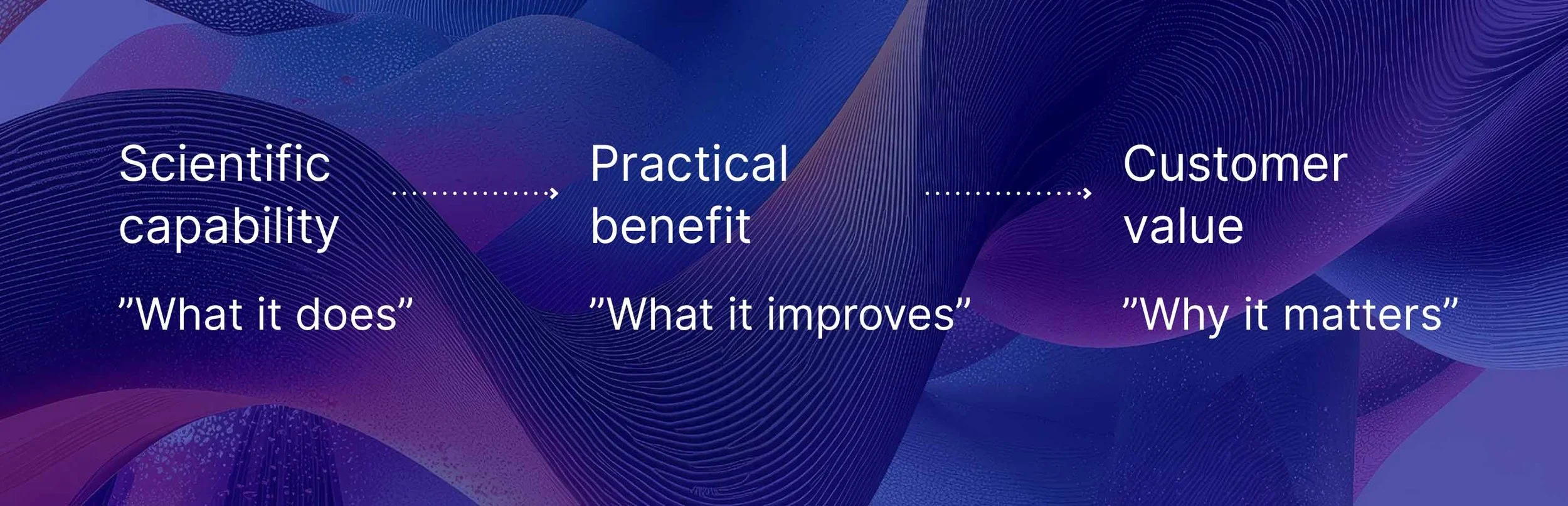
Consider a product that delivers results in fifteen minutes. From a technical perspective, that is a feature. The benefit is faster testing. The value, however, may be improved workflow, quicker decision-making, reduced waiting times, increased productivity, or better patient management. The feature itself is rarely what motivates action. Most customers are not actively looking for a specific technical specification; they are looking for a solution to a problem, an improvement in performance, a reduction in risk, or a more efficient way of working.
The same principle applies to virtually every scientific product. Higher sensitivity, improved accuracy, automation, or novel technology platforms are important, but only when customers understand what those capabilities mean in practice. Communication research has consistently shown that people are more likely to remember and act upon information when it is connected to meaningful outcomes rather than presented as isolated facts or technical details.
Effective communication helps customers bridge the gap between scientific performance and real-world value.
The communication gap we often see
After years of working with life science companies, we repeatedly encounter organizations that communicate from the inside out. They describe technologies, mechanisms, specifications, and the underlying science in great detail. Meanwhile, customers are trying to understand outcomes, risks, efficiency, ease of implementation, and business impact.
This disconnect is understandable. When teams spend years developing a product, they naturally become immersed in its technical strengths. The challenge is that customers do not share the same perspective. Before deciding whether something is relevant to them, they first need to understand why they should care. Only then are they likely to invest time in understanding the underlying science.
Organizations can also become blind to competitors and to the questions customers actually ask. In our experience, it is not uncommon to see companies that know every detail about their own product but pay surprisingly little attention to how competing solutions are positioned and communicated. Yet customers almost never evaluate products in isolation. They compare alternatives, compare promises, compare risks, and ultimately compare value.
How to turn science into customer value
Effective communication starts with an outside-in perspective. Rather than asking what the company wants to tell the market, organizations should focus on what customers need to understand in order to make a decision. This shift sounds simple, but it fundamentally changes how products are positioned, explained, and ultimately perceived.
It begins with understanding different stakeholders, the barriers to reaching them, and the factors that influence their decisions. Product features must be translated into benefits, and benefits must be connected to outcomes that customers value. The communication should make it easy for people to understand not only what the product does, but also why it matters.
Visual communication can play an important role in this process. Studies of learning and information processing have shown that complex information is often easier to understand and remember when verbal explanations are reinforced with effective visual representations. Good communication design helps readers navigate information, identify priorities, and focus on key messages. Strong messaging combines rational arguments with an understanding of the human factors that influence perception and decision-making, creating communication that is both informative and engaging.
Just as importantly, companies must remain aware of the competitive context. Customers compare products whether companies acknowledge it or not. Effective positioning therefore requires an understanding of how competing solutions are presented, what claims they make, and how your product creates distinct value in comparison.
Scientific excellence is only the beginning
Scientific excellence remains the foundation of success in life science and healthcare. Without it, there is little value to communicate.
But scientific excellence alone is rarely enough. The organizations that achieve lasting commercial success are often those that make it easiest for customers to understand why their science matters. They bridge the gap between technical capability and practical value. They help customers quickly grasp the benefits, understand the implications, and feel confident in their decisions.
See how we turn science into customer value
iDAScore — Communicating the value of AI-assisted embryo evaluation to IVF professionals.
LapSim ST — Turning the benefits of surgical simulation training into compelling communication that drove awareness and sales.
Log&Guard — Communicating the value of a specialised life science solution to its target market.
“Customers make decisions based on the outcomes they expect the features to deliver.”
“Effective communication starts with an outside-in perspective.”